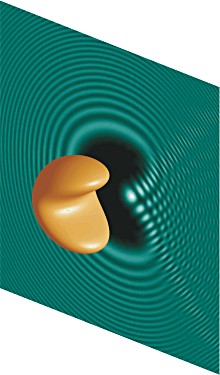
diffraction behind an obstacle Computational Science and Numerical Analysis

Computation is now regarded as an equal and indispensable partner, along with theory and experiment, in the advance of scientific knowledge and engineering practice. Numerical simulation enables the study of complex systems and natural phenomena that would be too expensive or dangerous, or even impossible, to study by direct experimentation. The quest for ever higher levels of detail and realism in such simulations requires enormous computational capacity, and has provided the impetus for dramatic breakthroughs in computer algorithms and architectures. Due to these advances, computational scientists and engineers can now solve large-scale problems that were once thought intractable.

Computational science and engineering (CSE) is a rapidly growing multidisciplinary area with connections to the sciences, engineering, mathematics and computer science. CSE focuses on the development of problem-solving methodologies and robust tools for the solution of scientific and engineering problems.

(quoted from "Graduate Education for Computational Science and Engineering"  SIAM Working Group on CSE Education.)

Computational science covers as broad array of problems arising in Mathematics, the sciences and engineering. The particular interests of our group members include computational nonlinear optics, electromagnetic scattering, nanophotonics, large scale computational fluid dynamics, modeling of semiconductor material inverse problems of Single Photon Emission Computed Tomography and modeling of partial differential equations with noise. Several of us are involved in large scale parallel computations both locally on Beowulf clusters as well as remotely using national supercomputer resources.

We have a regular weekly seminar in computational science and modeling that brings together faculty and students from across many disciplines.

The faculty who comprise our group are (alphabetically):

Moysey Brio, Paul Dostert, Robert Indik, Alexander Korotkevich, Paul Kraus, Leonid Kunyansky, Robert Maier, Juan Restrepo, Marek Rychlik, Mikhail Stepanov


Moysey Brio:
Prof. Brio works with the Arizona Center for Mathematical Sciences (ACMS). He and his group are involved in development of software for use in nanophotonics and plasmonics as well as computational electrodynamics. Significant advances in emerging fields of nanophotonics and plasmonics require sophisticated simulation software capable of resolving very fine nanoscale features embedded in relatively large micron-dimension devices. Advanced computational methods are the key engineering design tools that allow robust predictions prior to costly and time-consuming fabrication. At ACMS we are developing a comprehensive simulation environment that includes adaptive mesh refinement 3D Maxwell solver; spectral finite element (discontinuous Galerkin) methods in time and frequency domain; full vectorial moving mesh Beam Propagation method and 3D unidirectional Maxwell ultrashort pulse propagator that extends the nonlinear Schroedinger equation. A related area of research at ACMS is concerned with the modeling of material properties such as dispersion, absorption and gain. This is done on both quantum mechanical and a phenomenological level.

Paul Dostert:
Prof. Dostert primary interests are in uncertainty quantification for porous media flows.  He has used multiscale methods within the context of MCMC sampling methods for problems in hydrology and petroleum engineering.  His general interests include finite element methods, computational linear algebra, and parallel numerical algorithms.

Robert Indik:
Prof. Indik works principally in the area of computational optics.  He has been involved in detailed modeling of the interaction of coherent light with semiconductors, and is currently involved in modeling stochastic PDE's that arise in the modeling of light propagation in optical fibers.  He currently is doing the bulk of his computations on a 48 node Beowulf cluster with 1Gbs switched interconnect.  His interests include numerical linear algebra and parallel algorithms for solution of PDE's.

Leonid Kunyansky:
Prof. Kunyansky's research interest can be broadly described as computational wave propagation and tomography, with the emphasis on: problems of electromagnetic (EM) wave scattering by surfaces of conducting objects (see figure above); spectral problems of photonic crystals theory and inverse problems of Single Photon Emission Computed Tomography (SPECT). These classes of problems are unified by the underlying physics of wave propagation phenomena, and by even deeper mathematical links. The analysis of all these subjects is based on mathematical physics, integral geometry, and the theory of integral and partial differential equations. In turn, the development of techniques for mathematical modeling and numerical analysis of these problems requires use of applied harmonic analysis, theory of special functions, interpolation and approximation theory, and advanced numerical methods.

Robert Maier:
Prof. Maier works in several areas of applied mathematics that require heavy computational support. In collaboration with theoretical physicists he has explored the long-term effects of random perturbations on finite-dimensional and spatially extended systems. A numerically intensive problem is the computation of `failure modes' or `paths of least resistance' in the state space of a multistable system. One physical system now being modeled is a nanomagnet in a reversed magnetic field, subject to weak thermal perturbations. Such nanomagnets are used in data storage, and thermal noise can affect the ability of the magnetic field to reverse a stored bit. Prof. Maier is also active in the design and implementation of software for display graphics, and is the primary author of the GNU plotutils package (http://www.gnu.org/software/plotutils), which originated as a spinoff from one of his numerical modeling projects. He is an experienced software engineer and system software specialist, with additional expertise in TCP/IP and Web technologies.

Juan Restrepo:
Prof. Juan Restrepo has a long history of collaboration with scientific computing researchers at Los Alamos and Argonne National Laboratory. Most of his students spend summers at these labs training and doing research. He has worked on wavelet Galerkin techniques for the solution of hyperbolic problems. Codes for the computation of inner products involving Daubechies periodic wavelets were produced and are widely used by other researchers. With Argonne researchers, he has developed techniques for the exact calculation of a gradient of a function which achieves, at worst, logarithmic growth in storage and in cycles, thereby permitting this calculation on very large problems, which would otherwise be impossible on finite storage machines. Prof. Restrepo has worked on computational aspects of nonlinear estimation techniques, particularly in the optimal blending of models and data when the problems are highly nonlinear and/or far from Gaussian in statistics. He has built and used Beowulf clusters, the first one in operation in 1997. He uses these in large scale computational fluid dynamics problems and estimation assimilation studies. With his students he has developed software for massive computational parameter studies, and he produced the first ever massively parallel sound scape. At present he is developing a particle-based computational framework for modeling the dynamics of particles in flows as well as blood cells in a plasma, and with Maurice Hasson, is developing techniques for the detection of gaps in the spectra of normal matrices. He often teaches graduate numerical analysis.

Marek Rychlik:
Prof. Rychlik does research in computational algebraic geometry, computer algebra, numerical analysis and computational dynamics. He is an expert on Groebner basis and solving systems of polynomial equations with parameters. He has authored software packages CGBLisp and MaximaGrobner for performing calculations in this area, both written in Common Lisp. He is currently working on the Kuranishi-Cartan method, which allows one to automatically solve the local existence and uniqueness problem for systems of partial algebraic-differential equations (PDAE). It can also be used as a preprocessor for an implicit numerical algorithm like DASSL. His current project in computational dynamics is a fast simulator of the Bolzmann Gas, a system of hard balls in a box container, written in C++. Prof. Rychlik is also an author of a popular Java applet for numerically solving systems of differential equations on-line. Prof. Rychlik has an extensive experience in GUI design, computer algebra systems and modeling.